Sing To Me
2026
2026
Sing to Me
An Interactive Voice Installation
GH Hovagimyan
Interactive Installation / AI / Sound / Digital Performance
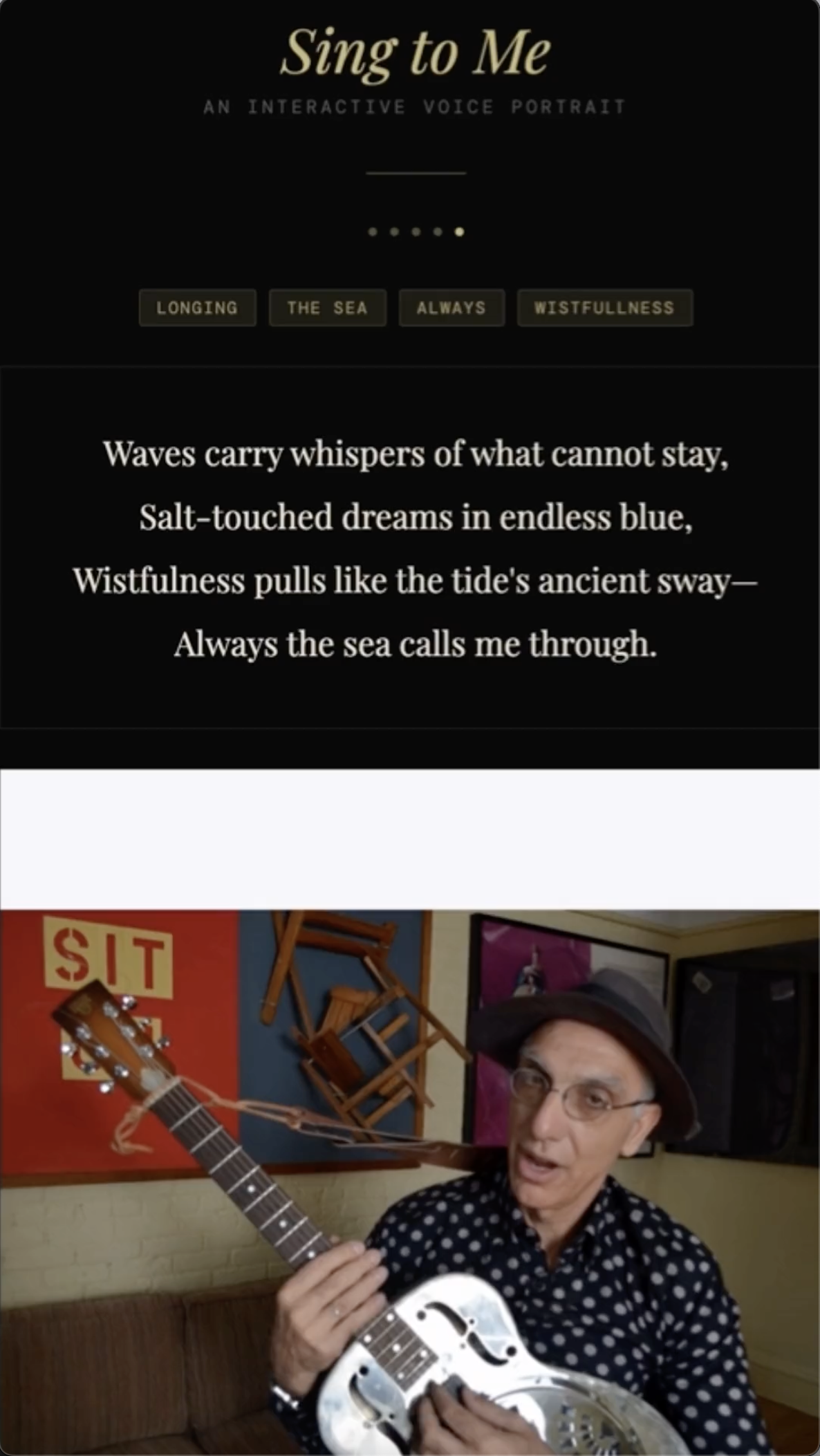
Sing to Me Is a freestanding kiosk installation in which visitors compose a song — not by writing, but by making a series of constrained poetic choices. A touchscreen presents four questions: How does it feel? — Longing / Defiant / Tender / Uneasy What does it circle around? — The sea / A stranger / My hands / The sky, When does it live? — Yesterday / Never / Always / Right now One word. Yours alone. From these four inputs, an AI language model generates a spare, imagistic four-line verse. That verse is then rendered in the artist’s cloned voice — trained on recordings of GH Hovagimyan’s own speech and singing — and delivered through a digital avatar of his face, which lip-syncs the performance in real time over a bed of live-recorded guitar riffs. The result plays through the kiosk’s speakers as the lyrics appear on screen. Each performance is unique. No two visitors hear the same song. The voice belongs to the artist, but the words belong to whoever is standing at the screen. The work also exists in a live performance configuration, in which the avatar sings over guitar riffs played by Hovagimyan in the same space — collapsing the distinction between recorded and live, body and simulation, composer and instrument. Concept and Context For thirty years, GH Hovagimyan has worked at the edge of the human and the technological. His practice began in the early 1990s in New York, when the Internet was still unmapped territory — a place where artists could ask genuinely open questions about identity, presence, and voice. Sing to Me extends this inquiry into new terrain. It begins with the artist’s own voice — trained, cloned, transformed into a model that can sing words it has never been given. The work asks what authorship means when a voice can be summoned without a body. It asks what happens when that voice is handed to a stranger, who feeds it language and listens to what comes back. This "constrained choice" architecture is itself a poetic form: visitors do not write, they curate. In doing so, they discover something about how meaning assembles itself from fragments — how a few words, a mood, and a subject can conjure something that feels, unexpectedly, personal. The work is a portrait that cannot sit still. It is co-authored by everyone who touches it. Technical Description Sing to Me is built on a pipeline that integrates several AI and audio systems: • A large language model (Claude, Anthropic) generates a four-line verse from the visitor’s selections. • A voice cloning system (Retrieval-based Voice Conversion / RVC) trained on the artist’s own recordings converts text-to-speech output into the artist’s vocal timbre. • A digital avatar (D-ID) lip-syncs the generated audio to a photograph of the artist’s face. • Guitar riffs recorded by the artist are assembled into a bed track, mixed beneath the vocal, and faded out at the end of each performance. • The entire pipeline — from visitor input to video playback — runs locally on a single machine. The kiosk installation requires: a freestanding touchscreen monitor or kiosk enclosure (provided by the artist), a dedicated internet connection for AI processing, a power outlet, integrated speakers, and approximately 6 square feet of floor space. The work is self-contained and requires no staffing during operation. Setup time is approximately two hours. Biography GH Hovagimyan is an experimental artist working across installation, digital performance, video, and interactive media. He was among the first artists in New York to work with the Internet and networked media in the early 1990s, and has continued to operate at the intersection of technology, identity, and the boundaries of the human. His practice spans hypertext works, digital performance, HD video, AR/VR/MR/XR, and interactive installations. He has exhibited and performed internationally, and engages persistently with questions of voice, authorship, and the shifting terms of human-machine relation. Sing to Me represents the convergence of his long- standing interests in the performing body, the networked image, and the poetics of constraint.
- -Selected Exhibitions and Performances - 2024 — Sing to Me (prototype), New York - 2020s — AR/VR/MR/XR works, various venues - 2010s — HD video and installation works, international venues - 2000s — Digital performance and networked installation, international venues 1990s — Early Internet and hypertext works, New York and international - The Museum of Modern Art, New York - The New Museum, New York - Centre Pompidou, Paris - Ars Electronica, Linz - Transmediale, Berlin